
SLC: Looking Back to Plan Ahead
Market Minute
July 2026 Newsletter
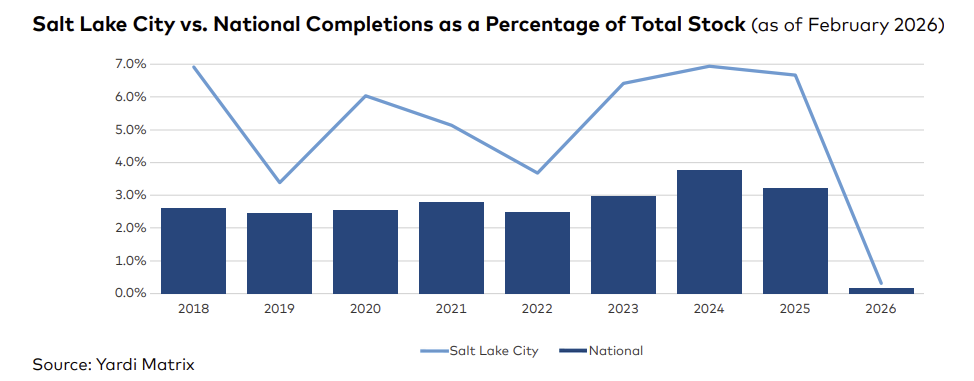
Yardi Matrix recently published their April 2026 Multifamily Report. It noted that Salt Lake City opened 2026 with rents still in negative territory as a decade-high wave of supply constrained pricing power. Advertised asking rents fell 0.4% on a trailing three-month basis through February. Stabilized occupancy held firm at 94.7%, up 10 basis points year-over-year, and the underlying economy remained sound—employment grew 1.4% (80 bps ahead of the U.S.), unemployment sat at 3.4%, and Education & Health Services led with 7,200 of the metro's 19,300 net new jobs.
The supply story defines the market: developers completed 9,430 units in 2025 (6.7% of stock, 350 bps above the national rate), a new decade peak, with another 10,082 units under construction and roughly 42,000 more in planning. Notably, groundbreakings are slowing—only 4,770 units started across 24 projects in 2025 as lending difficulties bite—which points toward eventual relief on the supply side. On the investment front, $641 million traded in 2025, a return to historic norms after the 2021–22 outlier years, with pricing up nearly 14% year-over-year to $238,111 per unit.
Key Takeaways:
Rents negative, supply-driven: T3 asking rents down 0.4% through February; Lifestyle down 0.4%, RBN (rent by necessity down 0.5%.
Occupancy resilient: Stabilized occupancy at 94.7% (+10 bps YoY) despite the supply surge.
Decade-high deliveries: 9,430 units completed in 2025 (6.7% of stock); 10,082 under construction, ~42,000 in planning, 78% of it Lifestyle product.
Pipeline cooling: Starts fell to 4,770 units (24 projects) in 2025 from 5,462 (28 projects) in 2024 as financing tightens—a signal of future supply moderation.
Investment normalized: $641M in sales volume in 2025, up from the prior two years; price per unit up ~14% YoY to $238,111.
Economy solid: 1.4% job growth, 3.4% unemployment; WGU's planned downtown campus projects 5,000+ jobs and $2.5B in capital spend over 20 years.
Submarkets to watch: SLC–Southeast led transaction volume ($149M) and posted 1.7% rent growth; only 13 of 33 submarkets saw YoY rent gains.
The full report also includes additional details on rent trends, economics, supply, and more! Email Sales@nxtmgt.com and we will send you the comprehensive report 📩
‘Nxt Level’
Case Study: Repricing, Recapturing, and Rebuilding NOI
When we took over management of a portfolio of two properties, both communities were sitting in the mid-80% occupancy range with rents that no longer reflected what the market would actually bear. The first move was a repricing exercise — aligning asking rents to current comps rather than to a rent roll built for unrealistic targets. Occupancy climbed to roughly 95%, and with it, the stability that makes every other operational improvement possible.
From there, the focus shifted to the revenue and expense lines that prior management had left on the table. Several garages had sat vacant at $150 per month, an above-market ask that was generating zero income. Dropping the rate to $100 filled them and converted a vacant rentable item into recurring monthly revenue. On the expense side, both properties had been leaning heavily on outsourced maintenance. We moved as much repair work as possible to in-house teams and routed any remaining vendor work through Regional Manager approval, tightening cost control at the point of spend rather than at the month-end variance report.
Occupancy and NOI improvements only hold if the asset itself holds. Alongside the financial work, the team prioritized curb appeal, cleanliness, and general property condition. That work supports resident satisfaction and retention, shortens the leasing cycle, and protects the rent growth the repricing unlocked in the first place.
What owners should take from this:
Stale pricing is an occupancy problem, not a revenue strategy. Rents above market don't preserve value; they create vacancy that costs more than the delta.
Ancillary assets need the same pricing discipline as units. An empty garage at $150 earns nothing. Priced to fill, it becomes recurring income with no additional operating cost.
Vendor spend is a control problem. In-house capacity plus a required approval layer changes the default from "call a vendor" to "justify a vendor."
Prior management's unfinished business is recoverable. Reserve replacement requests, unbilled recoveries, and missed reimbursements are worth auditing at every takeover — that's owner money sitting unclaimed.
Physical condition is a financial line item. Curb appeal and cleanliness show up in retention, leasing velocity, and ultimately NOI.

July’s Value of the Month is: Mind the Store. We act like owners and hold ourselves accountable. We own our culture, profitability, and success.
Ask the Editor

Question: How do I know if my property manager is approving tenants who are likely to cause problems down the road?
Answer: This is a great question and an important one for owners to ask. A single bad approval can cost you months of lost rent, legal fees, and turnover expense. The honest answer: no screening process can guarantee you'll never have a problem resident. But the difference between a manager who screens well and one who simply fills units is clear, and it comes down to the depth of their process and the tools behind it.
A strong screening program pairs technology with human judgment. Automated systems catch what's quantifiable, while manual verification — confirming employment, income, and rental history directly — catches the context a database can't. Any manager you trust with your asset should be able to walk you through exactly how they qualify an applicant, not just tell you they "run a background check." If the answer is vague, that's your signal to dig deeper.
Here's what our rigorous screening stack covers:
Credit screening with a customized scoring model: Reports pulled from all three major bureaus, run against a scoring model that produces consistent accept, conditional-accept, or reject decisions.
Synthetic fraud and identity detection: Real-time verification that an applicant's identity matches Social Security Administration records, flagging fraudulent CPNs (credit privacy numbers) and synthetic identities before they get through the door. This is increasingly critical as application fraud grows more sophisticated.
Comprehensive criminal screening: National, state, and county database searches, including the National Sex Offender Registry and OFAC/terrorist watchlist checks, applied consistently and in compliance with fair housing guidance.
Landlord–tenant dispute history: Civil court searches for prior evictions and monetary judgments, which are often the clearest predictor of future payment and behavior problems.
Verified rental payment history: Month-by-month payment records through national rental data exchanges, showing whether an applicant actually paid on time at their last residence rather than relying on a reference who may be eager to see them leave.
The takeaway for owners: ask your manager to describe their screening process in detail. A capable operator will layer multiple data sources, back them with manual verification, and apply the same criteria to every applicant to stay compliant. That combination won't make problems impossible, but it dramatically shifts the odds in your favor, and it's exactly what you're paying a professional manager to deliver.
As always, feel free to send any questions about the apartment world to sales@nxtmgt.com, and we would love to feature and answer the questions in next month’s newsletter.
Until next time,

